
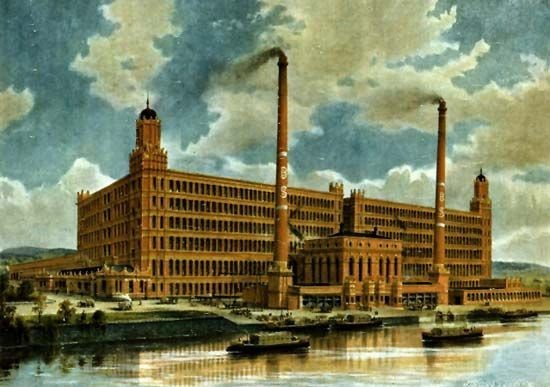
Broadstone Mill in Stockport, built in 1903 and expanded by 1907 to become the largest spinning mill in Europe, stands as a powerful symbol of the transformative changes brought about by the Industrial Revolution. The mill's history and its impact on the surrounding region highlight the significant shifts in technology, economy, and society that characterized this pivotal period in history. During the Industrial Revolution, the introduction of new machines and manufacturing processes revolutionized the textile industry.
The development of the spinning mule and the power loom allowed for the mass production of textiles, and large factories like Broadstone Mill emerged as hubs of industrial activity. The scale of Broadstone Mill, with its vast size and capacity for production, exemplifies the unprecedented growth and efficiency achieved during this era. The presence of such a large mill in Stockport also reflects the broader changes in the region's economy and demographics. The Industrial Revolution led to a massive migration of people from rural areas to urban centres, as factory work offered new opportunities for employment.
The growth of Broadstone Mill and similar factories in the area would have attracted workers from far and wide, transforming Stockport and its surrounding towns into thriving industrial communities. However, the Industrial Revolution also brought about significant social challenges. The working conditions in factories like Broadstone Mill were often harsh, with long hours, low wages, and dangerous machinery. The rapid urbanization led to overcrowding, poor sanitation, and the spread of diseases in industrial towns. The stark contrast between the wealth generated by the mills and the hardships faced by the working class highlighted the social inequalities of the time.
As the years passed, Broadstone Mill underwent numerous redevelopments, adapting to changing economic circumstances and industrial needs. The fact that it later became home to Mesmerise's development centre is a testament to the enduring legacy of the Industrial Revolution and its impact on shaping the modern world. The establishment of the development centre in the same building that once housed Europe's largest spinning mill is highly symbolic, as it heralded the beginning of a new industrial revolution-one driven by advancements in virtual reality (VR) and artificial intelligence (AI).
Just as the spinning mill represented a transformative moment in the mechanization of industry during the first Industrial Revolution, Mesmerise's development centre symbolized the potential for groundbreaking innovations and disruptive technologies to once again reshape our world. The rapid advancements in VR and AI are poised to revolutionize various industries, from entertainment and education to healthcare and manufacturing. As we embrace this new revolution of spatial computing and AI, we should expect a level of change comparable to that brought about by the first Industrial Revolution.
The widespread adoption of these technologies will likely lead to significant shifts in the way we work, learn, and interact with one another, much like how the mechanization of industry transformed society in the 19th century. While the specific changes may be difficult to predict, we can be sure we are on the cusp of a new era, one that will be shaped by the convergence of cutting-edge technologies and human ingenuity.