
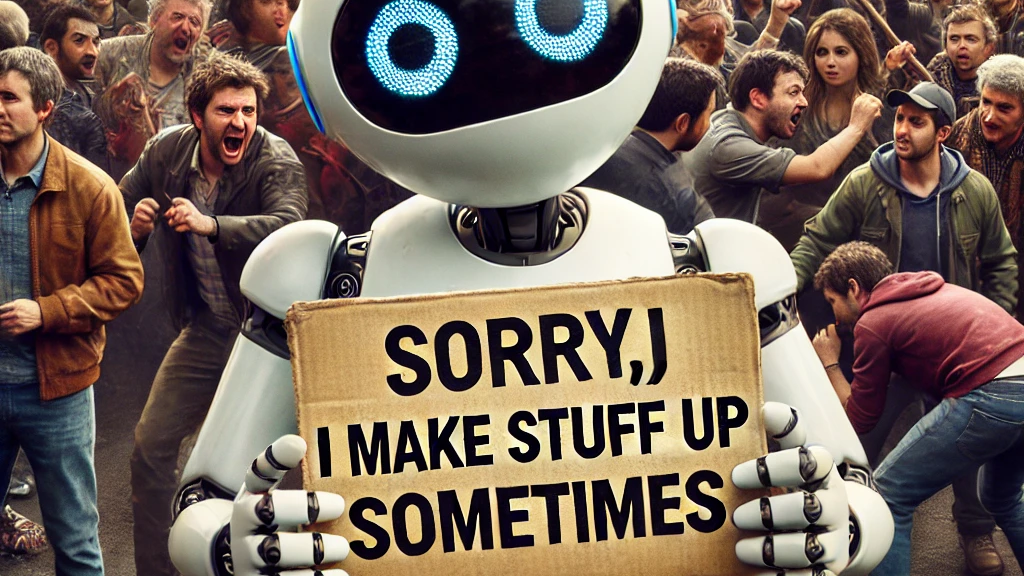
Let me start by saying I used to dislike the term hallucinations when it came to the seemingly erroneous output generation of AI transformers. It always conjured up an image of a fatigued servant system, deprived of sleep, food, and companionship, desperately trying to come up with an answer for its master's insatiable questioning-losing its grip on what's true and what's not (you know, like a person running on no sleep or sustenance). Part of this is accurate (minus the bit about food, sleep, and friends). ChatGPT, built on a predictive natural language processing framework, will often return spurious information if prompted in ways that encourage it to do so.
This isn't to place blame on the prompter for not recognising the system's limitations-though, admittedly, understanding its boundaries can help. Rather, it's a consequence of the model's design, and simply telling it "don't make stuQ up" doesn't work, as the system lacks a general awareness of what it's doing. The recent launch of search in ChatGPT, alongside best practices and validation processes, demonstrates that these hallucinations can be managed, if not entirely removed. Still, the strongest counterargument to AI systems occupying critical business roles is their perceived lack authenticity and honesty.
This concern is both reasonable and, to a degree, misplaced. We should have high expectations that the systems responsible for transforming data into information, knowledge and actionable insights be free from fabrications. If this is essential, then transformers like ChatGPT may not be the right tools for everyone. Other, more reliable methods exist for parsing large datasets and generating information. But the suggestion that because AI sometimes makes stuQ up isn't really the right one when dismissing the role it could play in your digital transformation - when exactly did humans become the guardians of honesty and gatekeepers of information?
We've proven time and time again that we're often far from reliable. Maybe we should start with our own standards. In the last five years, I've heard confident predictions from so-called industry experts that turned out to be stunningly wrong: - February 2020: "COVID isn't going to be a big issue. " - "Meta is finished after their 2021 ad sales figures. " - "There's no market growth left for Nvidia. " (in 2019) This isn't to discredit those making these predictions, but rather to show that the assumptions were reasonable given the knowledge gaps at the time.
Without complete information, people relied on their own internal knowledge and perspectives to predict outcomes-in other words, they sort of, "hallucinated. " I'd like to believe there was no hidden agenda behind these predictions, though our rationalisation process often includes biases that shape our conclusions. This is where, at least for now, we and machines differ. Having watched the UK elections and, with popcorn in hand, now following the US equivalent's season finale ( spoiler, they've replaced Ricky Gervais with even wilder characters), we may be witnessing the largest human-generated mass hallucination event in history.
Two fundamentally opposed sides seem to be fabricating information about each other to influence outcomes. It's increasingly challenging to discern fact from fiction, and I fear this deliberate, divisive misinformation is far more dangerous to the future of our society than ChatGPT not knowing how many "r"s are in strawberry. The levels of (human) misinformation and disinformation circulating in both the UK and US are oQ the charts, and this isn't innocent "gap-filling"-it's intentional, malicious, and engineered to fragment, alienate, and devalue communities across the political spectrum.
In summary: Yes, I'm currently less worried about ChatGPT making stuQ up or Dall-e adding the odd rogue letter in a sign it generates - I think we can fix that.